


Rice water is the starchy liquid produced when rice is washed, soaked or cooked. Its popularity as a hair rinse has led to claims about shine, strength and faster growth. Those are different outcomes, and a traditional use is not proof of a treatment benefit.
What the published research actually examined
A 2010 study by researchers at Kracie Home Products examined rice-washing water, called Yu-Su-Ru. Its abstract reports reduced surface friction and increased hair elasticity. It also reports flaking when rice water was used alone, which led the researchers to examine extracts instead.
Those findings do not establish that a home-prepared rinse makes human hair grow faster, treats hair loss or matches a formulated extract. This article discusses the published abstract; it does not claim that LoudFact tested the rinse.
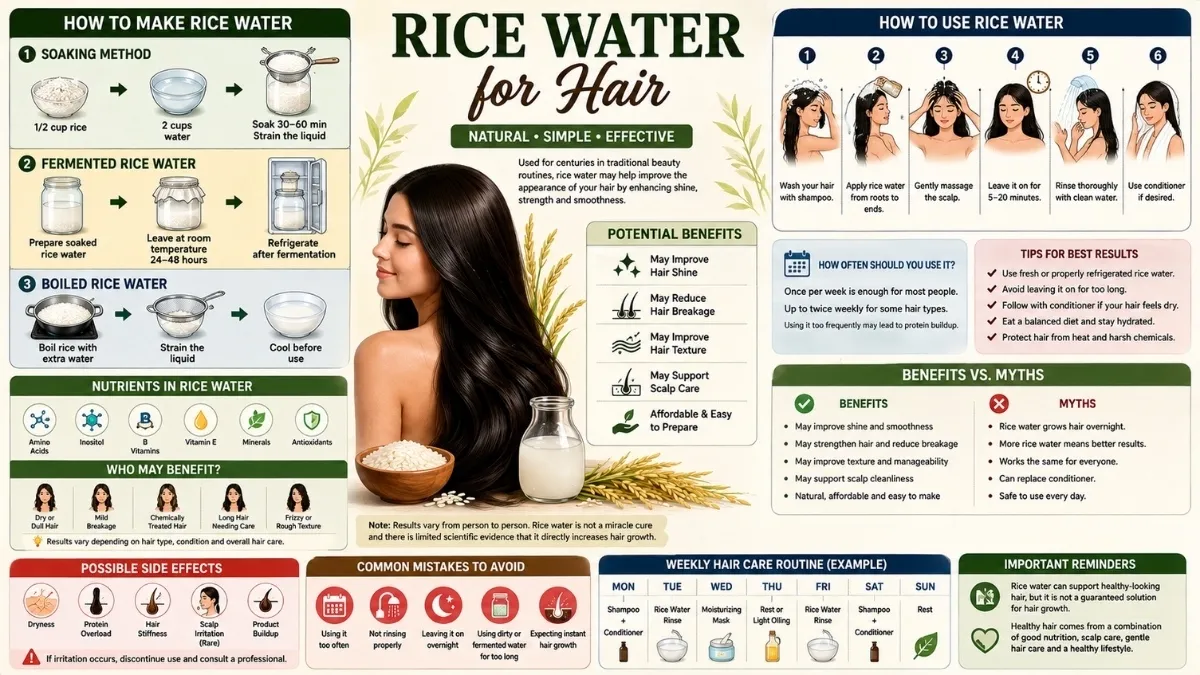
A nutrient list is not a hair-growth trial
The nutrients in rice do not tell you how much reaches a homemade preparation, how that mixture behaves on your scalp or whether it changes hair growth. A different feel after rinsing is not evidence that a follicle is growing new hair.
Why this guide no longer gives a DIY treatment schedule
The evidence reviewed here does not establish one mixing ratio, leave-on time or weekly schedule for different hair and scalp conditions. The earlier 5–20-minute application, once-or-twice-weekly schedule and room-temperature fermentation steps were not supported by a verified procedure here, so they have been removed.
This guide does not verify a storage life or claim that refrigerating a homemade mixture makes it safe. A formulated rice-containing product is a separate product: read its ingredient list, intended use and directions rather than transferring an online recipe to it.
If you are concerned about hair loss or irritation
The University of Minnesota Medical School reports dermatologist Ronda Farah’s caution that rice-water rinses may damage some hair, particularly coiled hair prone to breakage, and that nutrient content is not proof of benefit. Do not assume that a homemade rinse is harmless because its ingredients are foods.
Stop applying a preparation that irritates your scalp. If you are concerned about shedding, thinning or ongoing scalp symptoms, seek a diagnosis instead of relying on a rinse. The American Academy of Dermatology explains that the cause of hair loss guides treatment.
Common questions
The research cited here does not establish faster human hair growth from a homemade rice-water rinse. Changes in surface friction or hair feel are different outcomes from new growth.
This guide does not establish a safe or useful overnight application. For a formulated product, follow its own directions rather than an internet recipe.
The study discussed here does not establish that a home-fermented mixture is better or provide a validated fermentation and storage procedure.
There is no verified universal daily or weekly schedule in the evidence reviewed here. A commercial product should be used according to its own instructions.
A homemade rice-water rinse has not been shown here to replace a formulated conditioner. Choose hair-care products for their stated purpose and your needs.
Sources
Inamasu and colleagues: rice-washing water as a hair treatment (2010 abstract); University of Minnesota Medical School: rice-water claim cautions; AAD: hair-loss diagnosis and treatment.